
Personal · Home adaptation service
Accessible Trades
Approx. 5 min read
Creating and running a home-adaptation service across England, now used and shared internally by the MND Association.
- My role
- End-to-end product ownership, research, UX design, full-stack implementation and ongoing operation
- Status
- Live proof of concept, with ongoing development and feedback
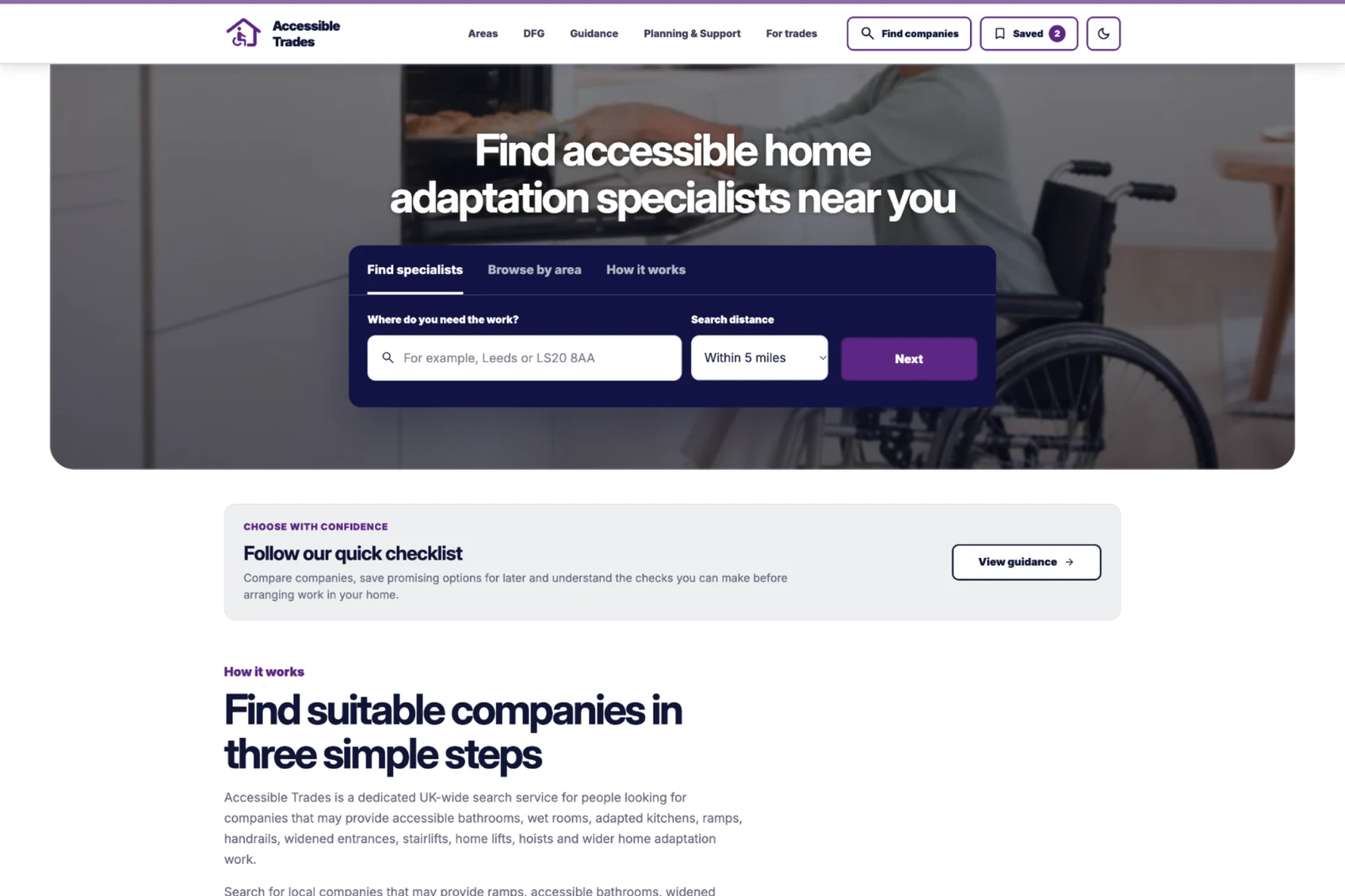
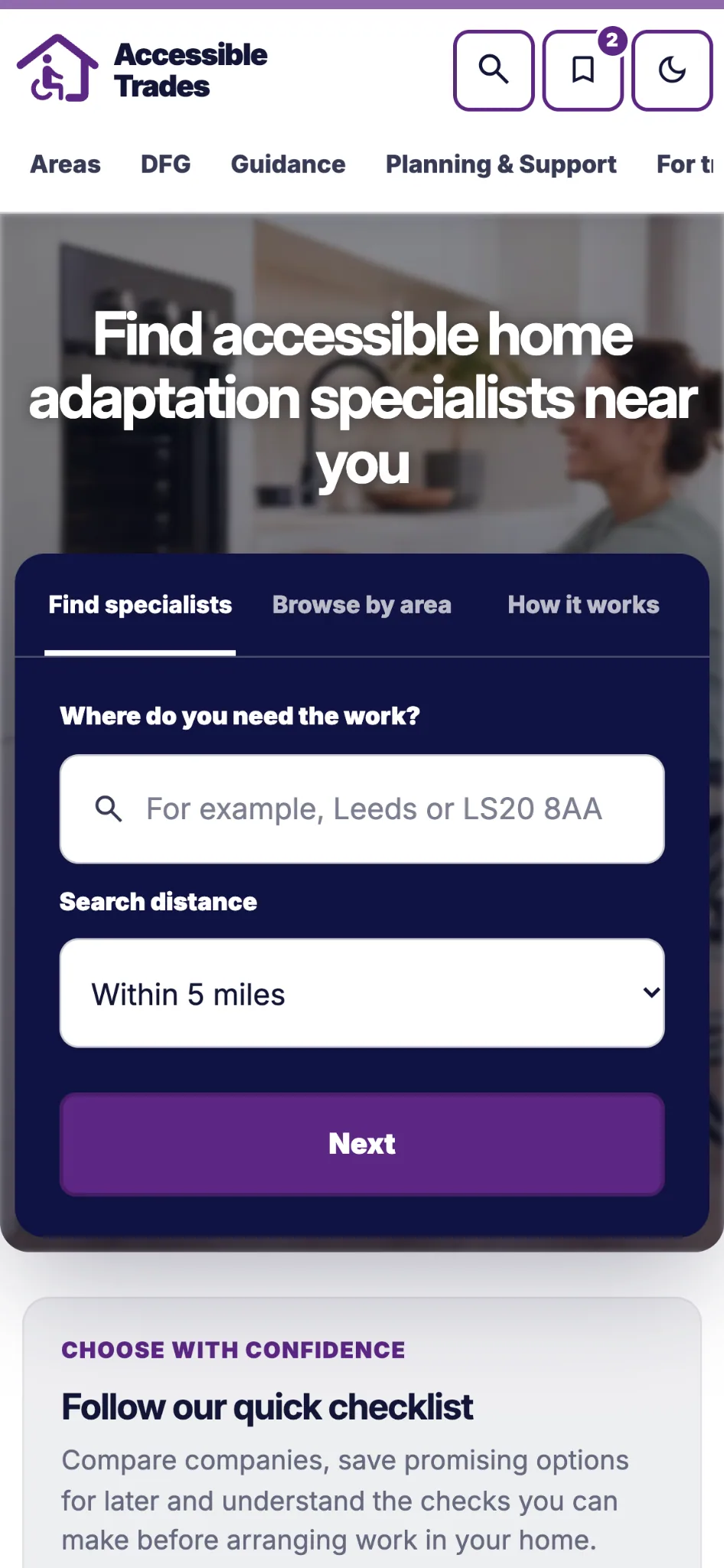
Mobile homepage · Location search and distance selection on the mobile homepage.
The problem and goal
The idea began while I was arranging work on my own home. Finding a reliable tradesperson made me consider how much harder that search could be for someone needing specialist adaptations. My advocacy for web accessibility prompted me to investigate whether a dedicated service already addressed that need.
In the services I reviewed, I found limited local coverage and adaptation categories within broader trades directories. I did not find a comparable service combining England-wide company discovery, supporting evidence and practical planning tools. My goal was to create a clearer starting point for people needing adaptations and those helping them.
My role and collaboration
I created and continue to run Accessible Trades, owning the product from the initial idea through to launch and ongoing development. My responsibilities span research, product direction, UX design, front-end development, backend API configuration, data management, hosting and SEO. I also built the company-management interface and maintain the service and its information.
I work directly with the MND Association’s partnerships team and nationwide support team. They have started using and sharing the service internally, and their feedback helps shape its direction and priorities.
Research and findings
My research combined competitor review, public statistics on ageing and home-adaptation needs, council information and investigation of Companies House records. The public information helped establish the context; reviewing existing services helped identify gaps in discovery and planning.
Council information and procurement notices could identify companies involved in adaptation work, but the information was spread across separate sources and was not always presented as a practical route to contact a company. I investigated business activity codes as a way to identify candidate companies, then used additional public evidence to assess their relevance.
I also found that planning guidance and tools were scattered across local and national websites. A carer supporting someone in another council area could consult information for their own address rather than the property needing work. These findings shaped both the company-discovery experience and tools that begin with the circumstances of the home being adapted.
Design approach and decisions
I designed the service around three connected needs: finding relevant companies, understanding the evidence behind a listing and preparing the next step. The aim was to make useful information available together while keeping its limits clear.
Make specialist discovery practical
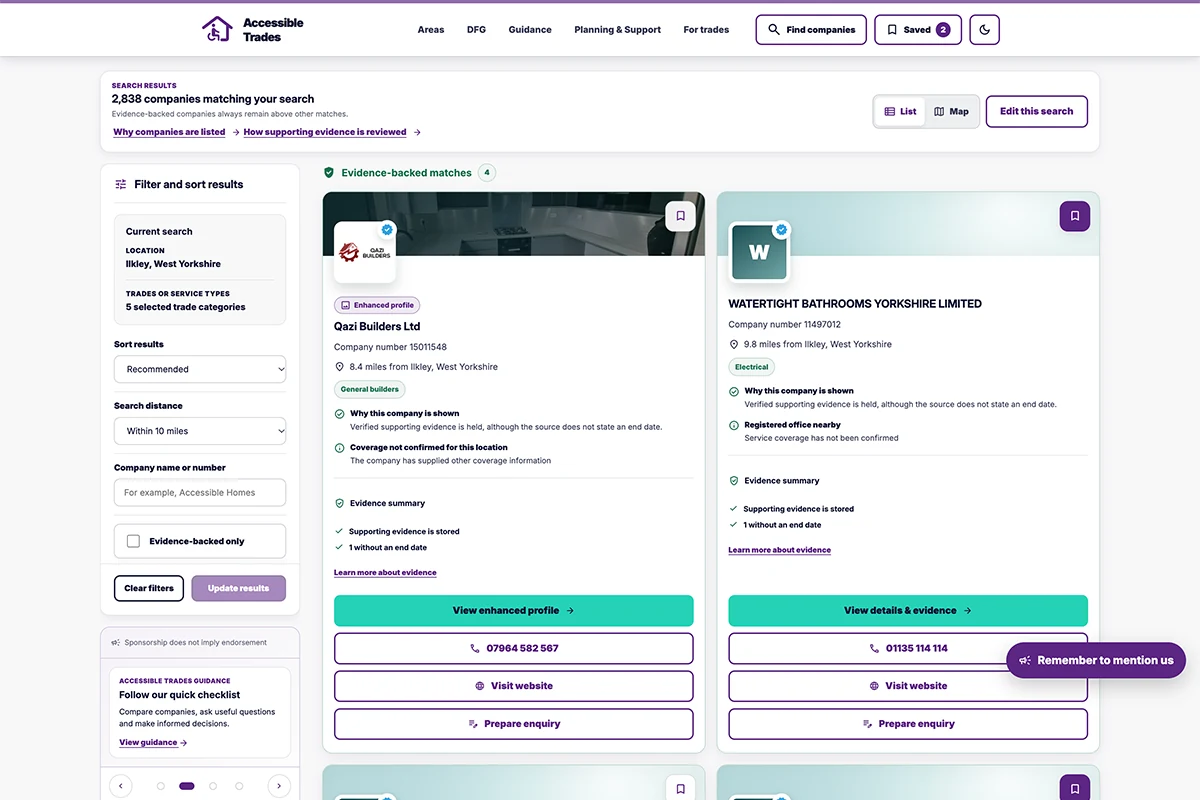
Location and trade filters help people narrow the search around the work they need. Results bring together company information, available contact methods and supporting evidence, with the option to save companies for later consideration.
I used automated data discovery and AI-assisted review to investigate potential company matches, followed by manual checks. This made broader coverage manageable without treating a business activity code or an AI suggestion as proof that a company provides suitable adaptation work.
Live service · Company search
Show what supports a company listing
I connected company records with relevant procurement evidence and reviewed public websites, adaptation services, previous-work examples and reviews where available. For submitted requests, I also checked the applicant’s details against the public company information. These checks help assess a listing; they do not guarantee workmanship or suitability for an individual project.
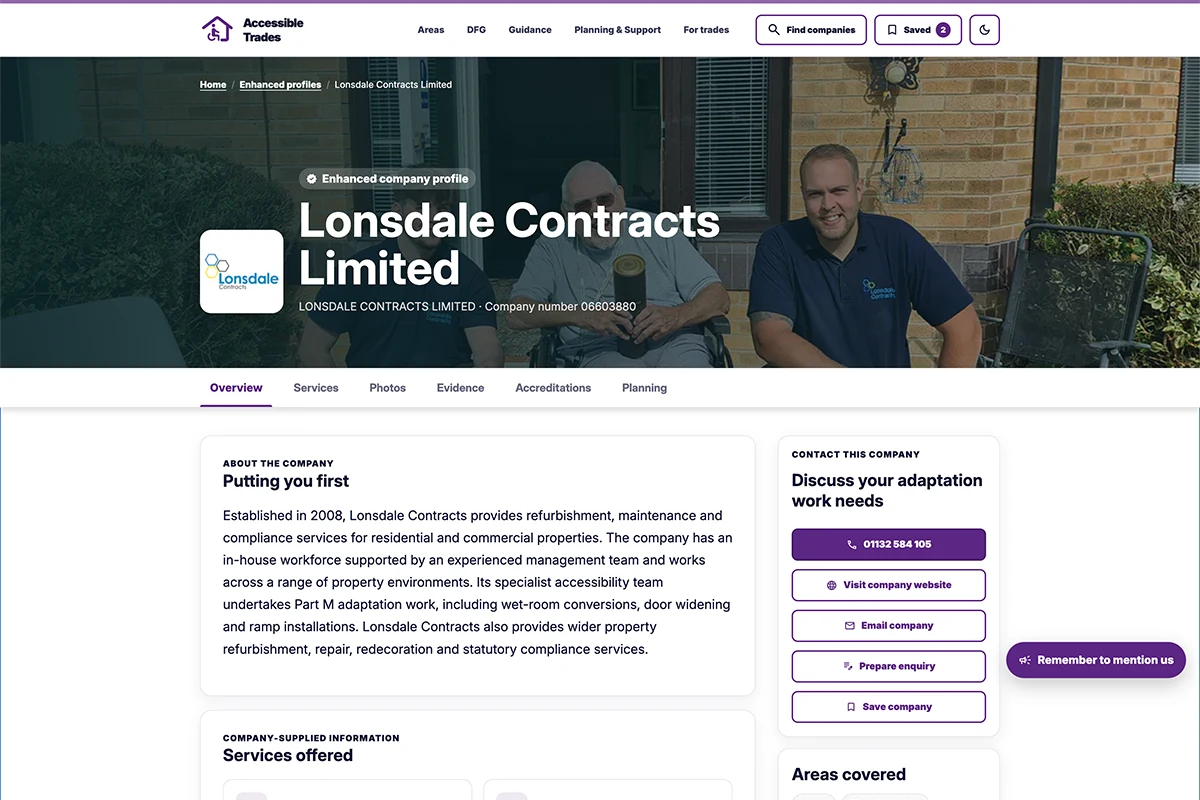
The company profile distinguishes company-supplied information from supporting evidence reviewed by Accessible Trades. For example, Bradford Council’s April 2024 award notice names Lonsdale Contracts Ltd on a framework for disabled facilities adaptation work. Linking that evidence gives people context they can inspect before making their own enquiries.
Live service · Company profile
Help people understand their next step
I brought planning guidance, saved companies and preparation tools into the same service. This supports people who need to understand funding routes or organise questions before they are ready to contact a trades company.
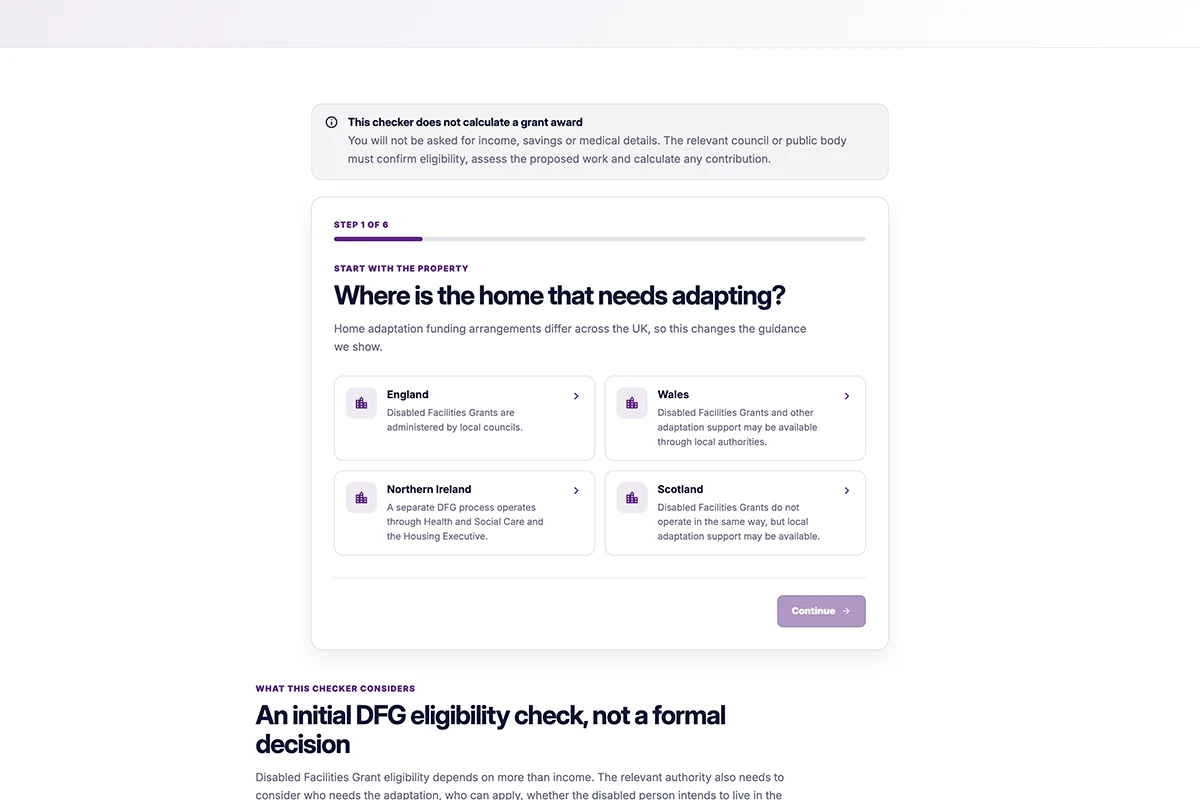
The funding-route checker uses a short sequence of questions and explains its limits upfront: it is an initial guide, not a council eligibility decision or grant calculation. A separate postcode-based council finder starts with the property where the work is needed, helping carers reach the relevant council even when they live elsewhere.
Live service · Funding guidance
Validation and iteration
I launched the service as a proof of concept and used a business social-media profile to explain its benefits and invite feedback. I also established direct feedback channels with the MND Association’s partnerships and nationwide support teams.
I am gathering feedback and reviewing usage data from visitors who consent to analytics, to identify where the experience needs to improve.
Delivery and outcomes
As of October 2026, the service has 240 evidence-supported company listings and its council coverage spans England. The MND Association has started using the service and sharing it internally. Its partnerships team has agreed a planned Helpful Links listing, which remains pending the next full review in February 2027.
I built a management interface for maintaining company records without changing application code. It also brings together analytics on company views and contact interactions where visitors have accepted the relevant analytics, helping me maintain the service and investigate usage.
I built the Vue 3 frontend and configured the API, using semantic markup and checks with Lighthouse and axe. The management interface lets me maintain listings without changing application code. Hosting costs remain below £10 per month at the current scale.
240
Evidence-supported listings
Company listings available on the service as of October 2026.
England
Current council coverage
Council coverage across England, with further expansion to the rest of the UK over time.
~£8.50 / month
Service running cost
Total monthly cost of running the service at its current scale, with API hosting on Render as the only ongoing expense.
Learning and next steps
The work reinforced that discovering a company is only one part of planning an adaptation. People may also need to understand local support, organise information and prepare a conversation. Designing the interface alongside the data and maintenance process helped me address that wider journey with a service I can continue to support.
My next step is to gather more direct feedback from people using the service and the teams supporting them. I want to understand whether they can find relevant companies, reach the right council and prepare their next steps. Usage data can help identify questions to investigate, while conversations and task-based evaluation can explain where the experience needs to change.